
Leo: The Green Rickshaw of Berlin’s Silent Paths The story of Easter Oster

The story of Easter Oster
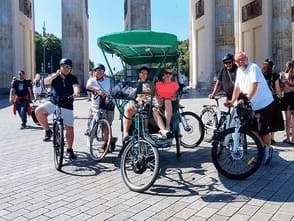
Leo the Green Rickshaw in Berlin – A Mystical Story Through Mitte, Tiergarten & Zoo Berlin
A long, atmospheric Eastern-style story set in Berlin. Follow Leo, the green rickshaw, through Mitte, Tiergarten, and Zoo Berlin in a journey of meaning and quiet transformation.
I. The City That Forgot How to Listen
In the heart of Berlin, where history pressed itself into stone and glass, there were streets that never truly slept.
In Berlin Mitte, footsteps overlapped endlessly—tourists, workers, dreamers, all moving with quiet urgency. Cafés spilt voices into the air, trams hummed like restless thoughts, and time seemed to rush forward without asking permission.
Yet even in such a city, there were places where silence still lingered.
Places where something older than the city itself waited.
And sometimes… it waited in the form of a green rickshaw.
II. Leo in the Modern World
No one knew when Leo first appeared in Berlin.
Some said it arrived after the war, rolling quietly through broken streets, carrying those who had lost everything. Others claimed it had always been there—only seen by those who needed it.
It stood out, unmistakably.
A deep green rickshaw, almost out of place among bicycles, buses, and polished cars. Its frame curved with an elegance that felt… ancient. Not antique—something beyond time.
And yet, people rarely questioned it.
In a city like Berlin, where past and present coexist, strange things are often accepted without explanation.
III. The Puller of Unspoken Roads
The man who walked beside Leo was known simply as Wei.
In Berlin Mitte, he moved through the crowds as though untouched by them. His pace was steady, never hurried, never delayed. People noticed him—but only for a moment, as if their minds could not quite hold onto him.
He did not call for passengers.
He did not advertise.
And yet, those who were lost somehow found their way into Leo.
IV. Through the Veins of the City
Leo did not follow the maps.
It moved through Berlin like a quiet thought drifting between louder ones.
One evening, beneath a sky painted in Paul’s gold, a young architect named Elias stepped into the rickshaw.
“Anywhere,” he said, tired in a way sleep could not fix.
Wei nodded.
Leo began to move.
They passed through Berlin Mitte—glass buildings reflecting a world that never paused, narrow streets holding whispers of older centuries, fragments of history layered beneath every step.
Elias watched, but his mind remained heavy.
“I’ve built so much,” he said quietly, “but nothing feels… real.”
Wei did not respond.
Leo turned.
V. The Forest Within the City
Soon, the city opened.
The noise softened.
They entered Tiergarten.
Here, Berlin exhaled.
Tall trees rose like silent guardians. Paths curved gently, as though guiding rather than directing. Light filtered through leaves in shifting patterns, like thoughts that refused to stay still.
Leo slowed.
The wheels barely made a sound against the path.
Elias leaned forward. “Why here?”
Wei finally spoke.
“Because this is where the city remembers how to breathe.”
They stopped.
Not at a landmark. Not at a destination.
Just… somewhere.
Elias stepped down.
For a moment, nothing happened.
Then—everything did.
The distant hum of the city faded. The wind moved softly through the trees. A stillness settled, not empty, but full.
Elias felt something unfamiliar:
Space.
VI. The Edge of Wildness
Days later, Elias returned.
But Leo was gone.
He searched through Tiergarten, through streets, through corners he had never noticed before.
Until one morning, near Zoo Berlin, he found it again.
Leo stood near the edge—where the boundary between the ordered and the wild blurred.
Children laughed in the distance. Animals stirred behind unseen enclosures. Life existed here in many forms, contained yet echoing something untamed.
Wei was there.
Waiting.
“You came back,” he said.
Elias nodded. “I don’t know why.”
Wei placed a hand on Leo.
“Then you are ready to go further.”
VII. The Journey Without Distance
This time, when Elias stepped into Leo, something felt different.
The city did not disappear.
But it softened.
Leo moved—not just through Berlin, but through something deeper.
Memories.Past choices.Past versions of himself.
He saw the buildings he had designed—not as achievements, but as reflections of who he had been at the time.
Rushed.Precise.Afraid to pause.
“Where are we going?” he asked.
Wei’s voice came like a distant echo.
“Nowhere.”
And yet, Elias felt as though he was travelling further than ever before.
VIII. Leo Remains
Years passed.
Elias changed his work. Slowed his life. Learned to build not just structures—but spaces.
Spaces where people could pause.
Where silence could exist.
Where meaning could unfold without force.
And sometimes, when the city felt too loud again, he would walk through Berlin Mitte, into Tiergarten, or near the Berlin Zoo.
Looking.
Not always finding.
But always remembering.
IX. The Green Rickshaw Still Waits
Leo is still there.
Somewhere in Berlin.
Not on any map.
Not in any guide.
But between places.
Between moments.
Between who you are… and who you are becoming.
If you ever walk through Berlin—
through the restless streets of Mitte, through the breathing paths of Tiergarten, or near the quiet edges of Zoo Berlin—
and you see a green rickshaw standing still…
Do not assume it is lost.
It is waiting.
And if you are ready—
Leo will take you on the only journey that truly matters.
Final Line
Not across the city.
But into yourself.
The story of Easter (Ostern) sits at the centre of Christian belief. Still, its roots stretch across both the Old and New Testaments, forming a continuous historical and theological narrative rather than a standalone event.
1. Foundations in the Old Testament
The Easter story begins long before the time of Jesus, in the Jewish scriptures—especially in the story of Passover.
In the book of Exodus, the Israelites are enslaved in Egypt. God raises Moses to lead them to freedom. The turning point comes during the final plague, when the firstborn of Egypt dies. The Israelites are instructed to sacrifice a lamb and mark their doorposts with its blood so that death would “pass over” their homes.
This event, known as Passover (Pesach), becomes a central Jewish festival commemorating liberation, sacrifice, and divine deliverance.
Key themes introduced:
Sacrifice of a lamb
Deliverance from slavery
Covenant between God and His people
These themes later become essential for understanding Easter.
2. Prophetic Expectations
Christians interpret several Old Testament passages as foreshadowing the events of Easter.
For example:
Isaiah 53 describes a “suffering servant” who bears the sins of others.
Psalm 22 contains imagery that closely resembles crucifixion.
These texts shaped expectations of a messianic figure who would suffer and bring redemption—not through political power, but through sacrifice.
3. The New Testament: The Story of Jesus
The Easter story itself unfolds in the Bible’s New Testament, particularly in the four Gospels (Matthew, Mark, Luke, and John).
The Last Supper
Jesus shares a final meal with his disciples during Passover. He reinterprets the bread and wine as symbols of his body and blood, linking his coming death to the Passover sacrifice.
Crucifixion
Jesus is arrested, tried, and executed by crucifixion under Roman authority.
Historically, crucifixion was a real Roman method of execution used for rebels and criminals. Most historians agree that Jesus of Nazareth was crucified around 30–33 CE.
Burial
After his death, Jesus was placed in a tomb.
Resurrection
According to the Gospels, on the third day, the tomb was found empty. Jesus appears to his followers, alive again.
This event—the resurrection—is the core of Easter. It is interpreted as victory over death and the fulfilment of earlier promises.
4. Historical Context
From a historical perspective:
Scholars widely accept the existence of Jesus and his crucifixion
The resurrection is a matter of faith, interpreted differently by religious believers and historians.
The earliest written accounts (Paul's letters, around 50 CE) already show that belief in the resurrection emerged very soon after Jesus’ death.
5. Connection Between Old and New Testament
Easter is not an isolated story—it is deeply connected to Passover:
Old Testament (Passover) | New Testament (Easter) |
Lamb sacrificed | Jesus as “Lamb of God” |
Blood saves from death | Jesus’ death brings salvation |
Liberation from Egypt | Spiritual liberation from sin |
Covenant with Israel | New covenant for humanity |
6. The Meaning of Ostern Today
In modern Christianity, Easter celebrates:
Resurrection
Renewal and hope
Victory over death
The German word “Ostern” may also have older, pre-Christian roots connected to spring festivals, which later merged with the Christian celebration.
The Easter story is not just a single event in the New Testament—it is the culmination of a long narrative that begins in the Old Testament with themes of sacrifice, redemption, and liberation. Historically grounded in the life and death of Jesus, it became a defining belief that shaped Christianity and continues to influence cultures around the world.
The familiar symbols of Easter—coloured eggs, rabbits, and spring imagery—did not originate in the biblical story itself. Instead, they developed over centuries as Christian beliefs merged with older seasonal traditions and cultural practices.
1. Pre-Christian Spring Traditions
Long before Christianity spread across Europe, many cultures celebrated the arrival of spring as a time of renewal, fertility, and new life.
In Germanic regions, some historians connect Easter to a possible spring goddess named Eostre (also called Ostara). According to the 8th-century monk Bede, a festival in her honour may have taken place around the same time as modern Easter.
While evidence is limited, the idea is important because:
Spring festivals already used symbols of fertility
Christianity later absorbed and reinterpreted these seasonal traditions
2. The Easter Egg
Eggs became one of the most widespread Easter symbols.
Origins:
In many ancient cultures, eggs symbolised new life and rebirth
Early Christians adopted the egg as a symbol of Jesus’ resurrection—the shell representing the sealed tomb, and cracking it symbolising new life emerging
Medieval Christian Practice:
During Lent (the 40 days before Easter), Christians often avoid eating eggs. By Easter, people had many eggs stored, which they:
Boiled to preserve them
Decorated and shared as gifts
In Eastern Europe, egg decoration became an art form, especially in Ukraine (pysanky).
3. The Easter Bunny
The Easter Bunny has more clearly folkloric than biblical origins.
Possible roots:
Rabbits and hares have long been symbols of fertility because of their rapid reproduction
They were associated with spring and renewal in European folklore
The idea of a rabbit bringing eggs seems unusual, but it likely developed in German traditions.
Historical development:
In the 17th–18th century Germany, stories emerged of an egg-laying hare called the “Osterhase”
German immigrants brought this tradition to America in the 1700s
Over time, the hare evolved into the modern Easter Bunny, delivering eggs and sweets to children
4. Blending with Christianity
As Christianity spread across Europe, it did not erase local traditions. Instead, it often adapted and reinterpreted them.
So:
Eggs became a symbol of the resurrection
Rabbits became part of a seasonal celebration
Spring imagery reinforced the theme of new life
This blending made the religious message more accessible to different cultures.
5. Modern Easter Traditions
Today, Easter includes both religious and secular elements:
Religious:
Church services celebrating the resurrection
Readings from the Bible
Holy Week observances
Cultural/Secular:
Egg hunts
Chocolate bunnies
Festive meals and family gatherings
These traditions coexist, even though they come from very different origins.
Easter traditions like eggs and the bunny are not directly from the New Testament, but they reflect older human ideas about life, renewal, and the changing seasons. Over time, these symbols were woven into the Christian celebration of the resurrection, creating the rich and layered holiday known today as Ostern.
If you want, I can go deeper into:
whether Eostre actually existed (historians debate this)
How different countries celebrate Easter
or the timeline of how Easter became a global holiday

Comments